
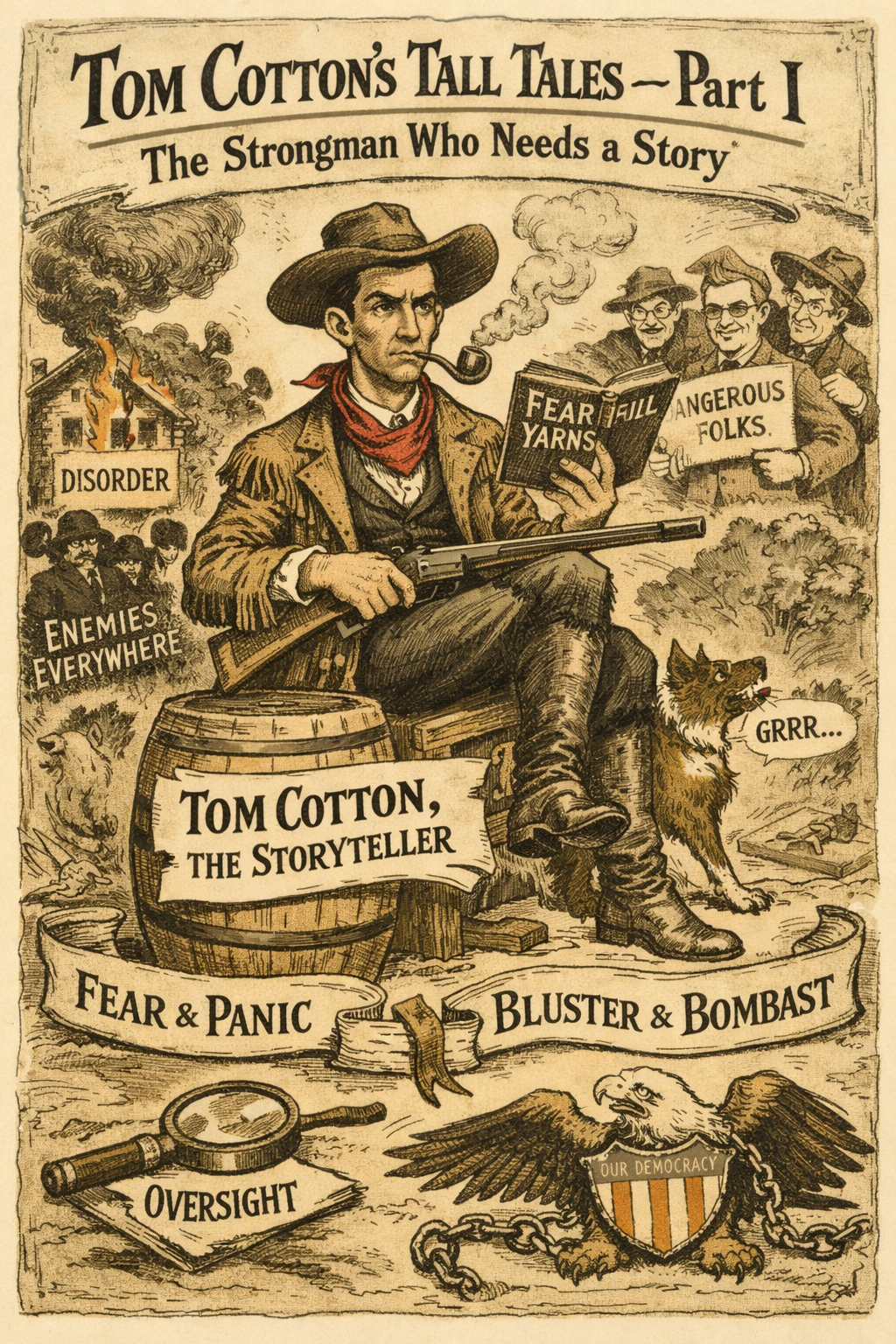
There is a particular kind of politician who does not argue policy so much as perform authority. Tom Cotton belongs squarely to that tradition. His public persona is built less on persuasion than on posture: the squared shoulders, the martial biography, the unblinking certainty. It is a style that asks voters not to evaluate ideas, but to submit to confidence. In this way, Cotton does not merely campaign. He narrates. And like most narrators who rely on force instead of evidence, he tells tall tales.
Cotton’s stories follow a familiar script. America is always on the brink. Enemies are everywhere. Disorder lurks just beyond the next protest sign. In these tales, complexity is flattened into menace, dissent into disloyalty, and ordinary citizens into threats. The details rarely matter. What matters is the emotional payload: fear sharpened into obedience. This is not conservatism as stewardship. It is conservatism as theater.
What makes these tales “tall” is not simply exaggeration, but inversion. Power is recast as vulnerability. The state becomes the victim. Institutions with overwhelming force claim fragility, while civilians exercising speech or concern are painted as dangerous actors. This inversion is useful. It justifies extraordinary responses to ordinary behavior. It converts accountability into betrayal. And it allows authority to escape scrutiny by declaring itself under siege.
Cotton’s rhetoric depends on a quiet bargain with the audience. If you accept the story, you will never have to ask uncomfortable questions. You will not have to distinguish between protest and violence, between criticism and treason, between oversight and sabotage. The tale does the work for you. It simplifies the world into heroes and villains, then asks you to pick a side without examining the script.
But tall tales have a weakness. They collapse under specificity. When names replace labels, when facts replace vibes, when real people replace caricatures, the story strains. That strain is visible in Cotton’s most aggressive moments, when the language accelerates, when the threats multiply, when the claims grow broader and less tethered to evidence. Urgency becomes a substitute for proof. Volume replaces clarity.
This is the first failure worth naming. A senator’s duty is not to frighten the public into alignment, but to govern on their behalf. Oversight requires restraint. Leadership requires proportion. Cotton’s tall tales offer neither. They trade trust for tension and call it strength.
Part II will examine what these stories do once released into the civic bloodstream—how they license escalation, excuse silence from peers, and turn real Americans into abstract enemies. Tall tales do not end when they are told. They end when they are believed.
McClure Magazine exists to document patterns, not chase headlines.
You are encouraged to quote, share, link to, and reference any article published here when it helps clarify a recurring issue or ongoing pattern. Attribution to McClure Magazine is appreciated and sufficient.No permission required.
No paywall on understanding.
Use it when it’s useful.
Leave a Reply