By Jason McClure
Every time America’s social problems come up—racism, bigotry, inequality—someone offers a familiar refrain: “If we could just fix the education system, all of this would go away.” The idea is simple and comforting: better schools would eliminate ignorance, and ignorance is the root of prejudice.
But here’s the twist: America’s education system has actually done remarkably well. It has lifted millions into literacy, numeracy, and opportunity. It has managed to teach the basics to nearly everyone. And it has done so in the face of fierce opposition from many of the very families and communities whose lives it is trying to improve.
This article isn’t about proving the schools have failed. It’s about explaining how well they’ve done — and why that success hasn’t been enough to overcome the louder force of values taught at home and reinforced by culture.
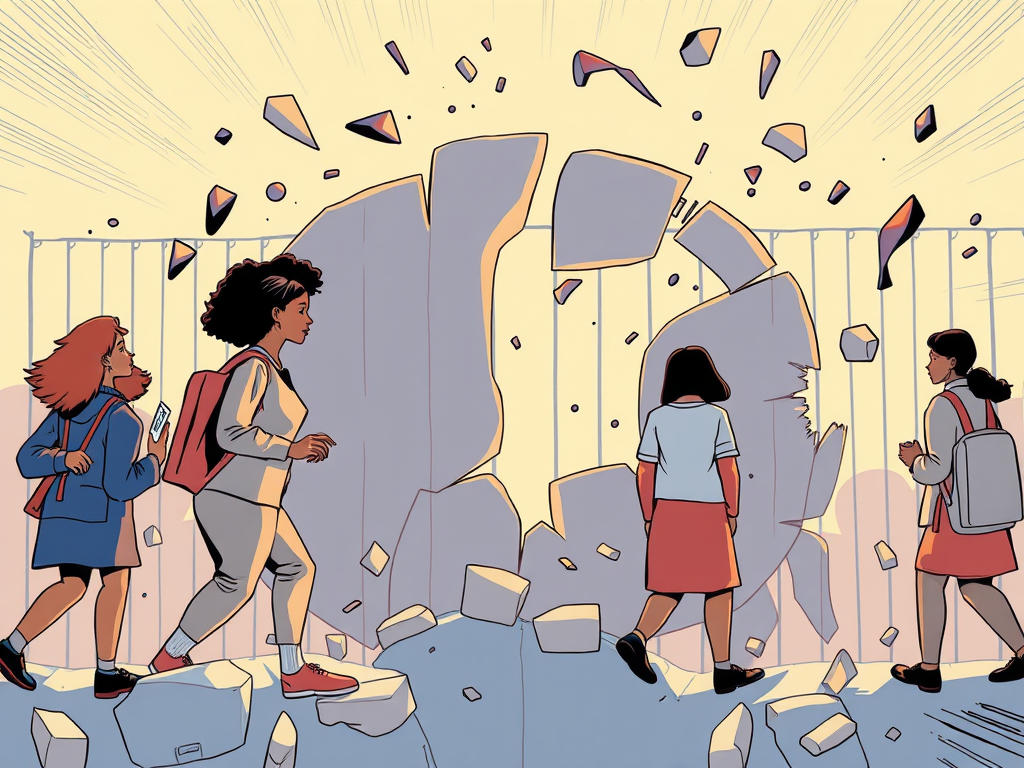
Education Isn’t the Real Barrier
For all its flaws, America’s education system has succeeded in its basic mission. Nearly everyone can read. Most people can handle arithmetic. Not everyone masters algebra or college-level writing, but basic literacy and numeracy are widespread.
The numbers tell the story. Roughly 21% of U.S. adults struggle with low literacy, and some surveys place it higher, closer to 28%. That’s a serious problem. But it’s still far less than the 30–40% of Americans who support a political movement openly rooted in prejudice.
In other words, there are far more bigots than there are illiterates. The barrier isn’t education alone.

The Problem of Projection
When we say, “if people were just educated, they’d make better choices,” what we’re really doing is projecting. We’re assuming that, with more knowledge, others would naturally arrive at the same conclusions we have. We’re assuming they share our values and that education will simply activate them.
But history tells us differently. Education doesn’t guarantee compassion. Literacy doesn’t guarantee empathy. People can be well-read and still choose cruelty. They can master math and still cling to prejudice. They can hold advanced degrees and still support authoritarianism.
That’s because education gives people tools—but values decide how those tools are used. A scalpel in the hands of a surgeon heals; in the hands of someone else, it harms. Knowledge without values doesn’t change the world for the better. Sometimes, it arms the very forces that work against progress.
When Elites Prove the Point
If education were enough, we’d expect the loudest voices in public life to be the most reasonable. But look at the opinion leaders shaping America’s opposition to inclusion. Tucker Carlson. Sean Hannity. Megyn Kelly. The list goes on.
These aren’t high school dropouts. They’re not illiterate. They’re not struggling to sound out words on a page. They’re college educated — in many cases at elite universities. Megyn Kelly even holds a law degree. These are people trained at the highest levels of American education, licensed professionals, some even graduates of the Ivy League.
And yet they use that education, that credibility, to argue against decency. To undermine social justice. To normalize prejudice.
It’s proof in plain sight: education doesn’t guarantee values. The most polished résumé in the world doesn’t mean someone will choose fairness over fear, or justice over self-interest.

When the Educated Fail on Values
I saw this dynamic up close when I worked in two different rural schools. You’d think that teachers — educated professionals, entrusted with shaping young minds — would rise above prejudice. But more than once, I saw the opposite.
One memory has stayed with me. I was on duty with two colleagues: another math teacher and an economics teacher who also taught history. The math teacher said to him, almost casually, “You know, I’ve been thinking — you might be right about the Civil War not being about slavery, but economics.”
These were not uninformed people. These were educated men, licensed teachers, people the community trusted to pass on knowledge. And yet here they were, rewriting history in a way that stripped it of its moral core.
And here’s the thing: I don’t believe this was just bad luck on my part, happening to land in two schools with the same dynamic. The odds are too slim. What I saw is almost certainly a nationwide phenomenon in rural schools — where teachers themselves carry and transmit these beliefs to kids.
That moment crystallized something for me: education doesn’t guarantee values. A degree doesn’t guarantee maturity. A classroom doesn’t guarantee justice. Knowledge without the right values can still end up serving prejudice instead of truth.
The Family Factor
Every one of those adults passed through classrooms. They learned how to read, how to subtract, how to sit through lessons on kindness and inclusion. Yet when it came to dignity and justice, they didn’t succeed. Why?
Because kids don’t grow up in a vacuum. They are shaped as much by what they hear at the dinner table as what they hear from a teacher. Schools can teach reading. They can drill multiplication. They can even launch anti-bullying programs. But no institution in a democracy is more powerful than the family when it comes to shaping values.
And today, families resisting inclusion are not just quiet outliers. They’ve become organized and loud. Anti-bullying lessons are reframed as “indoctrination.” Empathy is smeared as “grooming.” Discussions of race and history are attacked as “critical race theory.”
It’s not a shortage of education that fuels prejudice. It’s the reinforcement of contempt, passed through families and amplified in politics.
Education, Maturity, and Readiness
As a former teacher, I saw this firsthand. Teaching wasn’t only about reading or math—it was also about showing kids how to treat one another, how to handle conflict, how to grow into responsible people. In other words, it was about nudging them toward empathy and fairness.
But many weren’t ready. Some because they were kids—immature by nature. Others because they didn’t have the foundation to move up the ladder. A child worried about safety at home, about whether there’s food on the table, about constant instability, is not in a position to embrace higher values.
And this truth extends beyond children. Plenty of adults are immature too. And immaturity isn’t the same as illiteracy. The two overlap, but they aren’t identical. Education can provide the framework for maturity. But maturity itself requires development, self-awareness, and stability. One doesn’t guarantee the other.

Literacy and Motivation
It’s also worth pointing out that many of the “illiterate” in America aren’t truly unable to read. Most read at a fourth- or fifth-grade level. And if you can read at that level, you can improve.
The obstacle, then, isn’t just education. It’s motivation.
Education doesn’t stop with high school graduation. Adults can learn, too. Every community has a library. Almost every American has a cell phone. There are more resources than ever before to learn, grow, and improve. But not everyone chooses to use them.
Which raises a harder question: if the tools to improve are available, why don’t more people reach for them? That question again circles back to values, priorities, and maturity. Education can open doors. But only motivation walks through them.
The Maslow Problem
This ties directly into Maslow’s hierarchy of needs. Activists, progressives, and educators often ask people—particularly poor white communities aligned with MAGA politics—to embrace empathy and equality. At its heart, that’s a call to self-actualization, the highest level of Maslow’s pyramid.
But here’s the problem: many of the same people being asked to self-actualize are stuck at the bottom. They live with unstable jobs, broken healthcare, community decline, and economic precarity. They’re scrambling just to survive.
And when survival dominates, self-actualization feels unreachable. People lash out. Scarcity fuels anger. Anger hardens into prejudice.
This doesn’t excuse bigotry, but it explains why appeals to higher values often fall flat. You can’t ask someone to dream of justice when they’re still fighting for dinner.

Nature Knows It Too
You don’t need psychology textbooks to see this truth. Just look at nature.
I raise cattle, and I’ve noticed something simple: when the cows are well-fed, they’re calm. They graze, they move together, they behave. But when they’re hungry or neglected, they’re restless, aggressive, even dangerous.
It’s the same across the animal world. When creatures are cared for, they live in balance. When they’re starved or stressed, their behavior breaks down.
And we forget this sometimes, but we’re animals too. We’re mammals. If it works this way for them, why would it be any different for us?
Tribalism and Scarcity
Scarcity doesn’t just make individuals restless. It hardens groups. In the wild, animals stick to their herd or pack. When resources get scarce, boundaries tighten, and anything “other” becomes a threat.
Humans respond the same way. When people feel insecure—about jobs, healthcare, housing, or bills—they circle the wagons. They cling tighter to tribe. And in that climate, surface-level differences like race, culture, religion, and gender become fault lines.
The very characteristics of diversity that should enrich society instead become triggers for suspicion. Prejudice doesn’t always emerge from reasoned hatred—it emerges from fear, sharpened by scarcity.
The Larger Lesson
So maybe we need to stop pretending that fixing schools will fix the country. Schools can teach skills. They can even teach kindness. But they cannot override the values handed down in homes. They cannot erase the pressures of scarcity that keep people stuck in survival mode.
In a democracy, family values shape the culture. When families teach contempt, when immaturity resists growth, when scarcity fuels tribalism, schools can only chip away at the edges.
That leaves us with an uncomfortable truth: the real battleground isn’t only in classrooms. It’s in living rooms. It’s in neighborhoods. It’s in whether families and communities have the stability to rise above survival and embrace higher values.
Because in the end, schools can hand out knowledge. But it’s families—and the conditions they live under—that decide, loudly and visibly, what kind of society that knowledge serves.
And until we reckon with that, we’ll keep mistaking education for transformation—and keep confusing knowledge with wisdom
Other websites: AlgebraHelpDesk.com, AlgebraStepbyStep.com, and RepublicanFanFiction.com
 McClure Magazine
Leave a comment