Arkansas politicians are shoveling $27.5 million a year in tax breaks to out-of-state giants while small businesses scrape by on crumbs. Call it what you want—but it’s not “economic development.” It’s economic betrayal.
And the experts agree.
Harvard’s Michael Porter, the godfather of competitive strategy, puts it bluntly: “Subsidies for footloose corporations don’t build economies. They build dependency.”
That’s exactly what’s happening in Arkansas. The state keeps rewarding companies that will leave the second another state waves a shinier check—and the data proves it. Economist Timothy Bartik (Upjohn Institute) calls these incentives “a sucker’s game,” where taxpayers foot the bill for vanishing jobs and broken promises.
Meanwhile, Arkansas’s small businesses—the ones actually rooted in the state—are left fighting an uphill battle. This isn’t just bad policy; it’s a rigged system.
How the Game Is Rigged
Porter’s Five Forces model reveals the truth: Tax giveaways tilt the playing field. Big corporations get cheaper capital, political clout, and outsized market power—while local entrepreneurs struggle to compete against the very companies the state just paid to move in.
Take Bass Pro Shops in Central Arkansas. The retail giant got state incentives. The local sporting goods stores? Nothing. Now, they’re forced to compete against a tax-funded Goliath—without a lifeline.
But this isn’t just about retail. The same pattern plays out in manufacturing, steel, and beyond.
Osceola’s Steel Mill: Prosperity for Outsiders, Empty Promises for Locals
In Osceola, the mayor recently admitted that while the new steel mill offers good-paying jobs, many have gone to out-of-towners—workers who’ve quickly snapped up the city’s limited affordable housing.
What about the residents who were promised opportunity? Many lack the certifications or experience to qualify. One man told a regional outlet he’s applied repeatedly—still nothing.
This is the cycle:
- The promise of progress is dangled.
- The deal is signed.
- The tax breaks flow—and the real benefits leave town.
Let’s Do the Math
🏭 Arkansas Steel Mill Incentive:
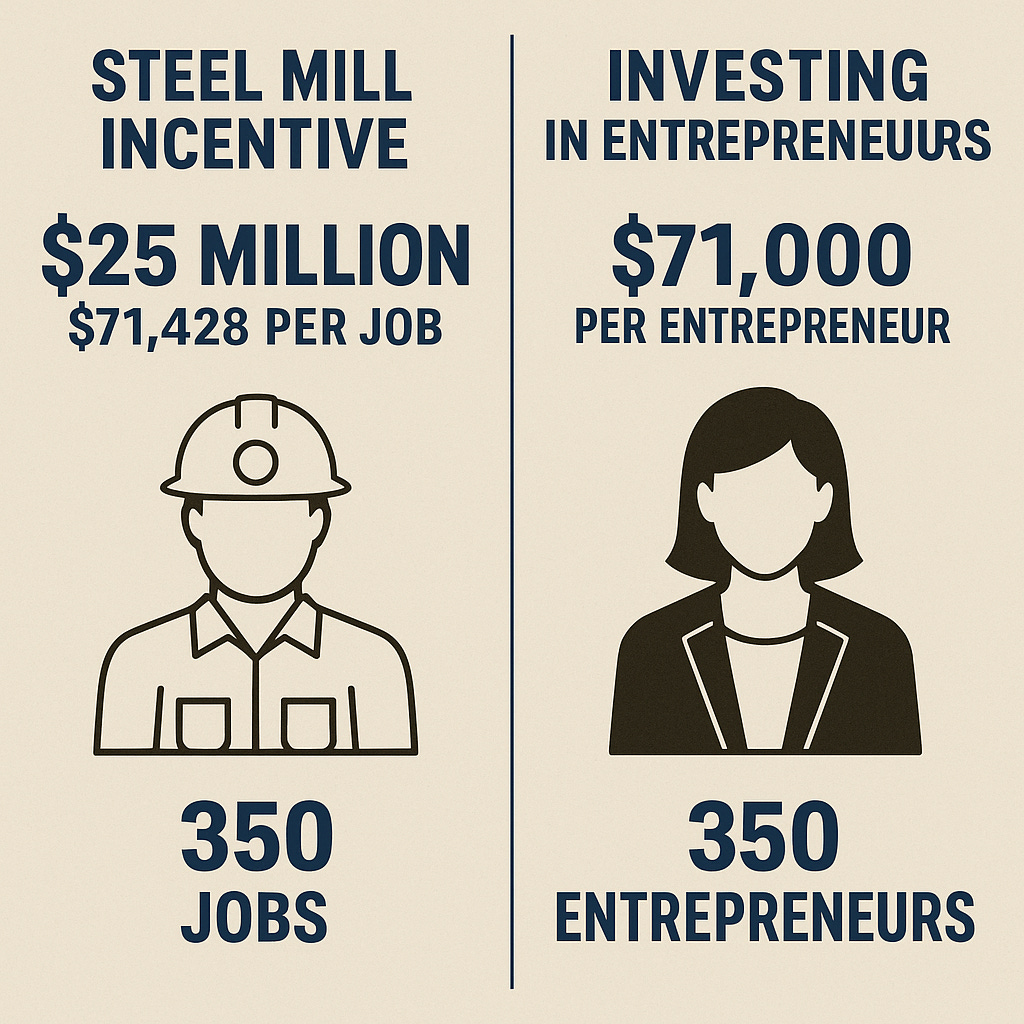
- $25 million → 350 jobs = $71,428 per job
Now imagine if that $25 million wasn’t a one-time corporate handout but an annual investment in Arkansans themselves—startup capital for 350 local entrepreneurs every year, with $71,000 each.
Would every business succeed? No. But that’s how real economies grow.
Even when a venture fails, the investment isn’t wasted:
- Skills are gained.
- Experience is earned.
- Confidence is built.
And often, a better business rises from the lessons learned.
That’s how America’s greatest economic engine has always worked—from the bottom up. Not from corporate boardrooms, but from people who want to build, create, and prosper—if we’d give them a fighting chance.
Why Politicians Keep Doubling Down
Most politicians aren’t cartoon villains (though some are). They want a legacy. So when they cut these corporate deals, they convince themselves they’re doing something historic.
But that belief fuels escalation of commitment—the dangerous instinct to double down even when the facts change.
Instead of reassessing, they:
- Oversell the benefits.
- Minimize the human cost.
- Tie their reputations to the outcome.
And corporations? They see that desperation—and exploit it.
The result? More concessions. More PR. Fewer results for the people footing the bill.
A Better Way Forward
Suppose Arkansas lawmakers actually cared about growing the economy. In that case, they’d stop bowing to corporate lobbyists and start investing in the people who never left—the ones who hire local, stay local, and fight for progress without a $25 million safety net.
Redirect those funds into:
✅ Local small-business grants
✅ Vocational training and certifications
✅ Affordable housing for workers
✅ Infrastructure that supports everyone
Don’t just chase companies. Build communities.
Final Word: This Is About Dignity
This isn’t just about economics. It’s about:
- Small business owners who were told they mattered—until they didn’t.
- Workers who were promised opportunity—and watched it pass them by.
- Arkansas’s future, sold off piece by piece to the highest bidder.
It’s time to flip the script. Not just for efficiency—but for fairness.
🖊️ If this made you think—share it. Stitch it. Drop a comment.
Because accountability starts when we stop letting hypocrisy slide.
👇 What do you think Arkansas should invest in next?
 McClure Magazine
Leave a comment